

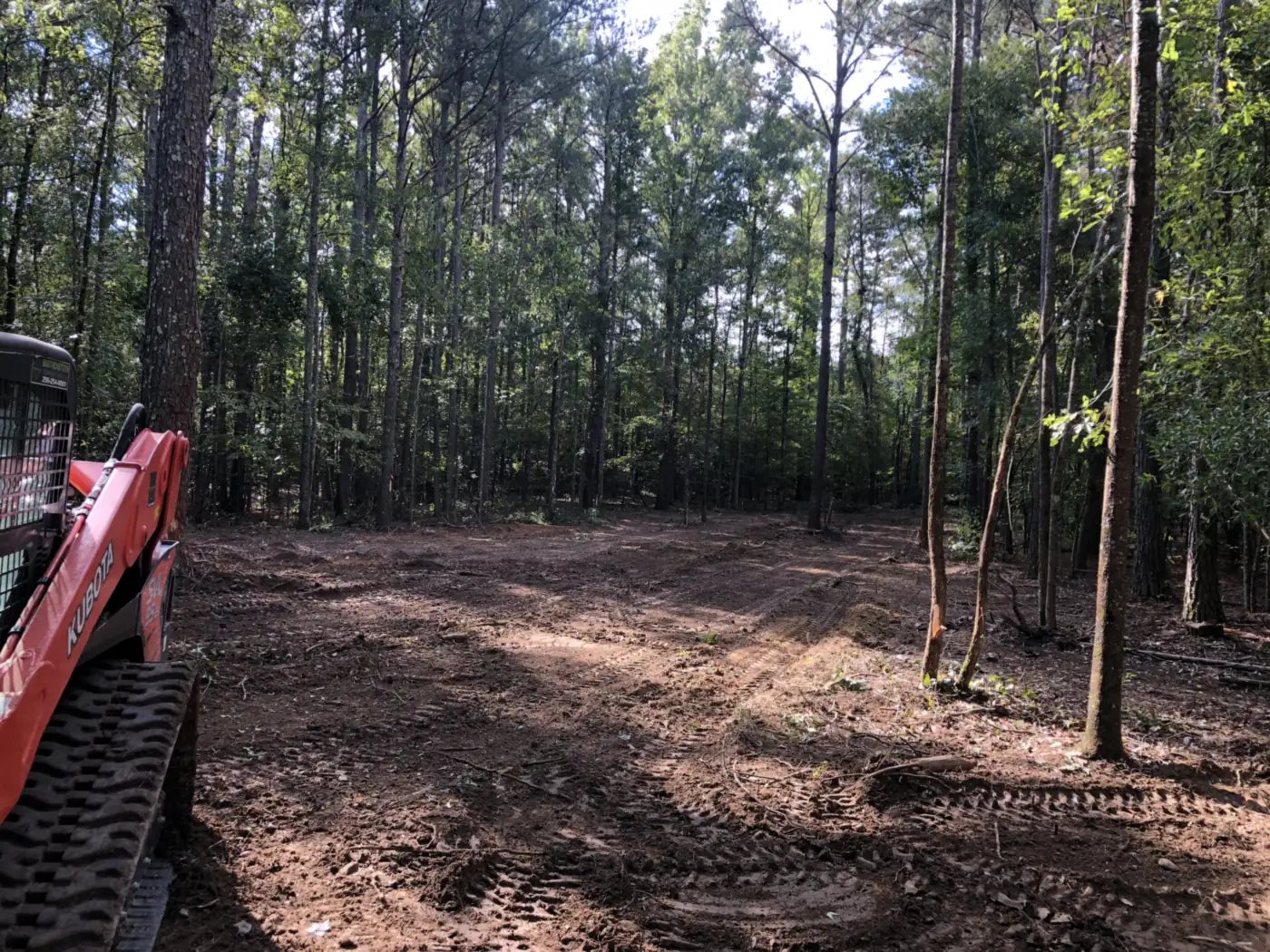
Overgrown pasture along the ridges above Soddy-Daisy or a wooded lot near Harrison Bay doesn’t have to mean weeks of cutting, piling, and burning. Boundless Excavation & Contracting offers forestry mulching throughout the Chattanooga area — a single-pass method that grinds brush, saplings, and small trees into mulch right where they stand, instead of leaving a pile of debris behind. It’s faster than conventional clearing, it skips Tennessee’s debris-burn permit process entirely, and the mulch layer it leaves behind helps control erosion on sloped ground while your project timeline moves forward. Whether you’re reclaiming pasture, opening up a building envelope, or clearing a fence line, our mulching crews can typically be on site within days. Call (423) 615-4885 for a free estimate.
What Forestry Mulching Actually Involves
Forestry mulching is a land-clearing method that uses a single machine — a skid steer, track loader, or excavator fitted with a mulching head — to cut, grind, and clear brush and small trees in one pass, rather than cutting, piling, and hauling or burning debris separately. Our mulching heads run carbide-tipped teeth on a high-speed rotating drum, powered by high-flow hydraulics, and can process standing brush and trees up to roughly eight to ten inches in diameter directly into mulch. Before mulching starts, we walk the property to flag what’s staying — fence lines, mature trees, drainage paths — since a mulcher is precise enough to clear right up to a line without disturbing what’s beyond it. As the machine works, ground vegetation, saplings, and understory disappear into a fine mulch bed left in place; there’s no burn pile, no hauling trucks, and no bare dirt left exposed to wash out in the next rain. What starts as a tangle of privet, cedar, and briars becomes a walkable, mulch-covered surface the same day, ready for grading, fencing, or seeding.
Our Forestry Mulching Process
Step 1 — Property Walk & Scope: We walk the site with you first to mark what’s being cleared versus what’s staying — property lines, fence rows, specimen trees, drainage. This is also where we confirm the finish you want: park-like open ground, selective thinning that leaves mature trees standing, or a complete clear.
Step 2 — Mulching Pass: Our operators run the mulching head through the vegetation in overlapping passes, grinding brush and small trees into mulch as they go. Dense areas or bigger stems may need a second pass for a cleaner finish; light brush and grass usually clear in one.
Step 3 — Selective Detail Work: Around fence lines, structures, and trees you’re keeping, we work the mulcher in tighter, more careful passes rather than running the same wide sweep we use in open ground — this is where operator experience matters most.
Step 4 — Mulch Spread & Site Cleanup: We spread the resulting mulch evenly rather than leaving it in windrows, so it breaks down and controls erosion instead of smothering the ground in thick clumps. Any equipment ruts get smoothed before we leave.
Step 5 — Walkthrough: You get a final walkthrough to confirm the finish matches what we discussed, and we flag anything you should know before your next phase — grading, fencing, or seeding.
Serving Chattanooga and the Surrounding Area
We run forestry mulching jobs across Hamilton, Rhea, and Meigs counties — pasture reclamation out toward Dayton and Georgetown, lot clearing along Highway 27 through Soddy-Daisy and Sale Creek, and right-of-way and fence-line mulching on rural acreage near Birchwood and Bakewell. Learn more about our full lineup of land and site services.
Because mulching leaves the ground covered rather than bare, it’s a common choice on the sloped terrain around Flat Top Mountain and the ridges near Chickamauga Lake, where bare dirt after clearing would otherwise wash out in the first hard rain. On flatter valley ground with cherty clay-loam soil, mulching is just as effective but the erosion-control benefit matters less — it comes down to what the property actually needs.
Why Chattanooga Homeowners & Builders Choose Boundless Excavation & Contracting
Josiah Sims built Boundless Excavation & Contracting around the same equipment and hands-on experience he’s had since childhood, and forestry mulching is one of the crews he’s actively growing so land clearing and mulching can run as their own dedicated operation rather than a task squeezed between other jobs.
Mulching is also the practical choice if you’d rather not deal with Tennessee’s burn-permit rules. Under Tennessee Division of Forestry regulations, any open burning of land-clearing debris within 500 feet of a forest or woodland requires a permit during burn season (October 15 through May 15), and larger broadcast burns need one year-round. Because mulching disposes of debris on site instead of burning it, most of our mulching clients skip that process altogether.
We offer free estimates and can usually get a crew out within a few days. Learn more about our team or call (423) 615-4885 to schedule a walkthrough.