Before a foundation goes in, water, sewer, and electrical lines have to get from the street — or the well and septic system — to the house, and every foot of that trench is regulated by Tennessee law. Boundless Excavation & Contracting installs underground utilities for builders and property owners throughout the Chattanooga area: water lines, sewer lines, and utility trenching for new construction and site development. We coordinate the Tennessee 811 locate on every job before equipment touches the ground, so lines get installed where they belong without damaging what’s already there. Call (423) 615-4885 for a free estimate on your utility trenching or line installation.
What Underground Utilities Actually Involves
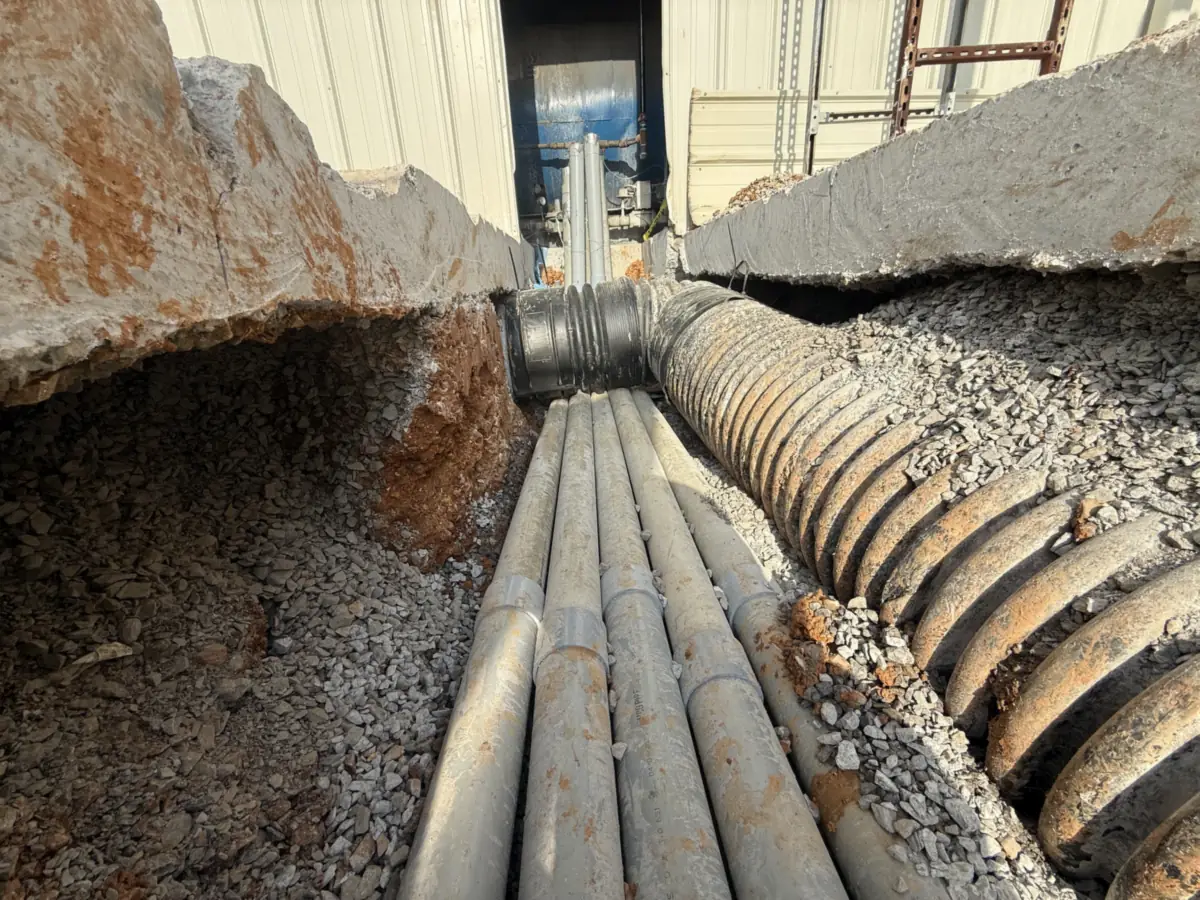
Underground utility installation covers trenching and laying the water lines, sewer lines, and electrical or gas conduit that connect a structure to its service source — whether that’s a municipal line at the street or, on rural acreage, a well and septic system on the property itself. Before any digging starts, Tennessee’s Underground Utility Damage Prevention Act requires a locate request through Tennessee 811 at least three business days ahead, so member utilities can mark existing lines and we’re not trenching blind. Once lines are marked, we excavate and trench with an excavator or trencher sized to the job, set pipe or conduit to the depth and slope the design requires — sewer lines need consistent fall to drain properly, water lines need adequate cover — and backfill in lifts to avoid settling later. On a new-construction site, this usually happens alongside or right after grading, since the same equipment and much of the same trench work often serve both. What starts as a site with service at the street or a well at the edge of the property ends with water, sewer, and power routed to the exact spot your structure needs it.
Our Underground Utilities Process
Step 1 — Tennessee 811 Locate: We submit a locate request to Tennessee 811 at least three business days before any digging, so every utility company with lines near the site has a chance to mark them. We won’t trench until that window closes, even if it means the schedule slips a few days.
Step 2 — Trench Layout: We lay out the trench route to connect the structure to its service point — municipal lines at the street, or a well and septic system on rural acreage — accounting for required depth, slope, and separation from other utilities.
Step 3 — Excavation & Trenching: Depending on the job, we trench with an excavator for larger utility runs or a dedicated trencher for narrower runs like water service, keeping to the depth the design requires.
Step 4 — Pipe & Conduit Installation: We set pipe to the correct slope — critical for gravity sewer lines — and install conduit for electrical runs, checking connections before anything gets covered.
Step 5 — Backfill & Compaction: We backfill in lifts and compact as we go rather than dumping a trench full of loose dirt, which is what causes settling and a sunken trench line months later.
Serving Chattanooga and the Surrounding Area
We run utility trenching and installation on projects throughout Hamilton County — new-construction sites in Ooltewah and East Brainerd where water and sewer connect to city lines, and rural acreage out toward Georgetown, Birchwood, and Dayton where a well and septic system serve the property instead. Learn more about our full site development services.
Because so much of our utility work happens alongside septic installation and site grading on the same rural lots, we’re used to coordinating trench routing around a drain field or a rock outcrop rather than working from a flat, obstruction-free plan — the reality on most acreage between Sale Creek and Dayton.
Why Chattanooga Homeowners & Builders Choose Boundless Excavation & Contracting
We treat the Tennessee 811 locate as a hard requirement on every job, not a step we skip when the schedule’s tight. Tennessee’s Underground Utility Damage Prevention Act requires it by law, and hitting an unmarked line is expensive, dangerous, and entirely avoidable.
Trenching deeper than five feet falls under OSHA’s excavation and trenching standards, which require a protective system — sloping, shoring, or a trench box — unless the trench is cut entirely through stable rock. We follow those requirements as standard practice, not just when an inspector’s on site.
We offer free estimates and typically coordinate the 811 locate as soon as you call. Learn more about our team or call (423) 615-4885.