If you’re building on acreage outside city sewer lines anywhere from Soddy-Daisy to Dayton, chances are new septic system installation is one of the first calls you’ll need to make. Boundless Excavation & Contracting handles septic system installation throughout the Chattanooga area — new installations for new construction and undeveloped lots, not repairs or pump-outs. Hamilton County’s terrain varies from clay-loam valley soil to rocky ridges near Chickamauga Lake, and the system that works on one lot won’t necessarily work on the next, which is why we start with a soil evaluation, not a standard design pulled off the shelf. Josiah is training a dedicated septic crew so this work gets the same focus as our land clearing and grading teams, not squeezed in as an afterthought. Call (423) 615-4885 for a free estimate.
What New Septic Installation Actually Involves
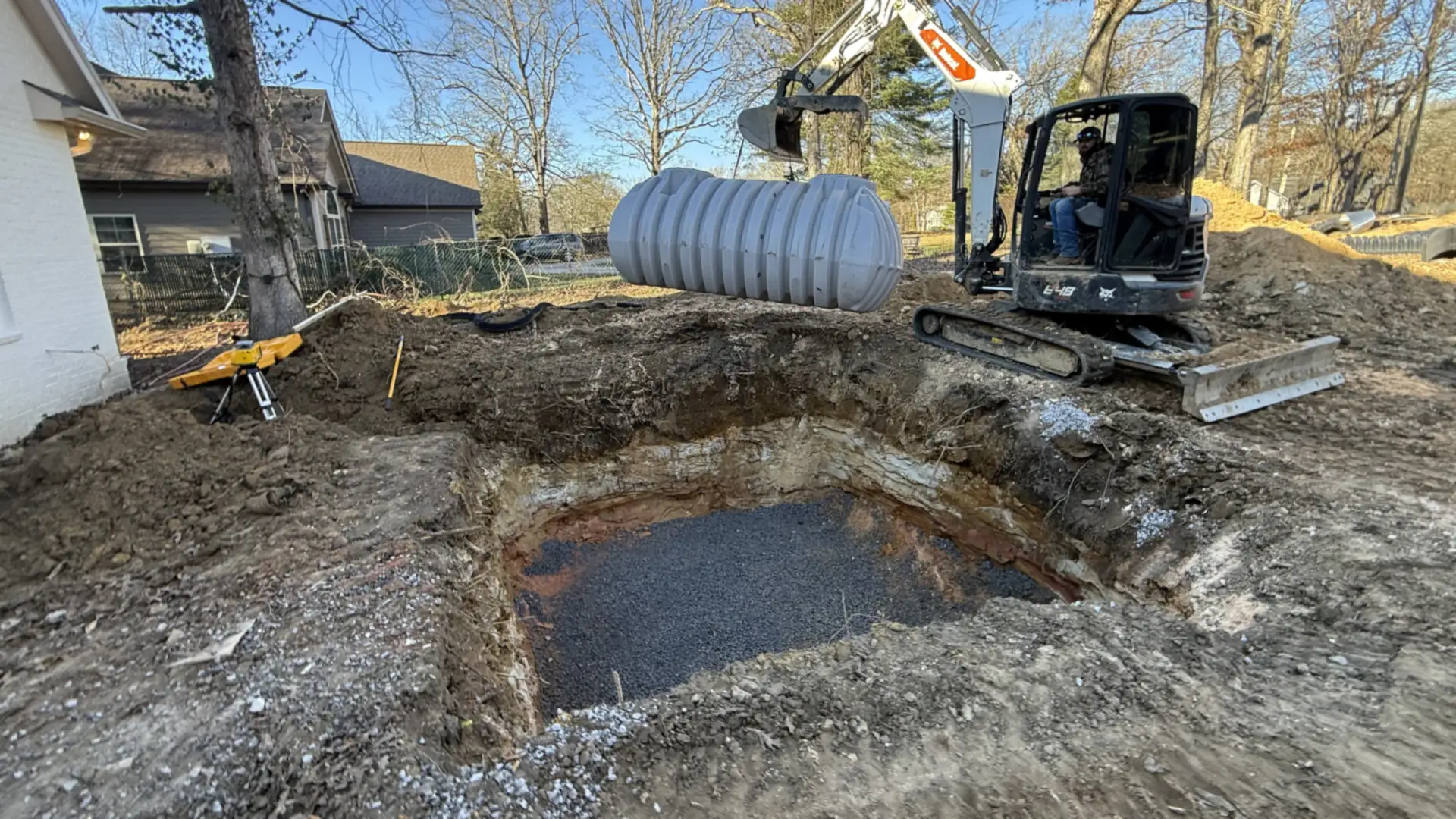
Septic system installation is the process of putting in an on-site wastewater treatment system — a tank plus a drain field — for a property that isn’t connected to municipal sewer, which describes most of the acreage outside Chattanooga’s city limits. In Tennessee, that starts with a percolation test and soil evaluation from a state-approved soil scientist, since Tennessee’s regulations for subsurface sewage disposal set trench depth, soil-absorption rates, and setbacks based on what’s actually in the ground — cherty clay-loam in the valleys drains differently than the shallow, rocky soil common near ridgelines. Once the soil evaluation comes back, the design determines whether the lot supports a conventional gravity system (perforated pipe in gravel-lined trenches) or requires a low-pressure pipe system, which is common where rock sits closer to the surface. From there, our crew excavates and sets the tank, trenches and installs the drain field to the design depth, backfills, and coordinates the county inspections required at each stage — tank set, lateral lines, and final cover — before anything gets buried for good. What starts as a bare, unbuildable lot ends with a permitted, inspected system your builder can pull a foundation permit against.
Our New Septic Installation Process
Step 1 — Soil Evaluation & Percolation Test: Before any design work happens, a licensed soil scientist evaluates your lot and runs a percolation test to determine how fast the soil absorbs water. This single step decides almost everything else — trench depth, drain field size, and whether you’re a candidate for a conventional system or need a low-pressure pipe design. If the test’s already been done, we build to it; if not, we’ll get one scheduled.
Step 2 — Permit & Design: With soil data in hand, we handle the permit application through the county environmental office and Tennessee’s regulations for subsurface sewage disposal, sizing the system to your home’s bedroom count and the site’s absorption rate.
Step 3 — Excavation & Tank Installation: We excavate for the tank and set it to the depth the design calls for, with the outlet elevation coordinated to the drain field so effluent flows by gravity, or by pump on a low-pressure design.
Step 4 — Drain Field Installation: We trench and install the absorption field — gravel-bedded perforated pipe for a conventional system, or pressurized lateral lines for a low-pressure design — at the depth and spacing the county-approved design specifies.
Step 5 — Inspection & Backfill: County inspectors check the system at the stages required, before backfill on the tank and lines, and we coordinate every one of those inspection windows so the job doesn’t stall waiting on a missed call. Once approved, we backfill and grade the area, and you’re left with a permitted system and the paperwork your builder needs.
Serving Chattanooga and the Surrounding Area
We install septic systems throughout Hamilton, Rhea, and Meigs counties — new construction lots around Soddy-Daisy and Dayton, acreage near Sale Creek and Bakewell along Chickamauga Lake, and rural home sites out toward Georgetown and Birchwood where public sewer was never an option. Learn more about our full site development services.
Soil in this part of Tennessee isn’t uniform, and that matters more for septic work than almost anything else we do. Valley ground tends to be cherty clay-loam over limestone and shale, which can drain slowly enough to need a larger field; closer to the ridgelines around Flat Top Mountain and Signal Mountain, shallow rocky soil often pushes a design toward a low-pressure pipe system instead of a conventional gravity field. We design to whichever your lot actually calls for, not whichever is cheaper to install.
Why Chattanooga Homeowners & Builders Choose Boundless Excavation & Contracting
Septic work is one of two services Josiah is building Boundless Excavation & Contracting specifically around — new installs, not repairs — with a dedicated crew and equipment set aside for it rather than treating it as a side task for the grading team.
New septic installation in this region is regulated under Tennessee’s rules for subsurface sewage disposal systems, and permits, inspections, and licensed-installer verification run through the county building department — for Hamilton County, that’s the Hamilton County Building Inspection Department. We coordinate every stage of that process — soil evaluation, permit application, and each required inspection — so you’re not the one chasing down paperwork.
We offer free estimates and can typically schedule a soil evaluation within days of your call. Learn more about Josiah and the Boundless Excavation team, or call (423) 615-4885.